
Home / CORE Blog / Good design is invisible: Guido Casalegno on product design
Good design is invisible: Guido Casalegno on product design
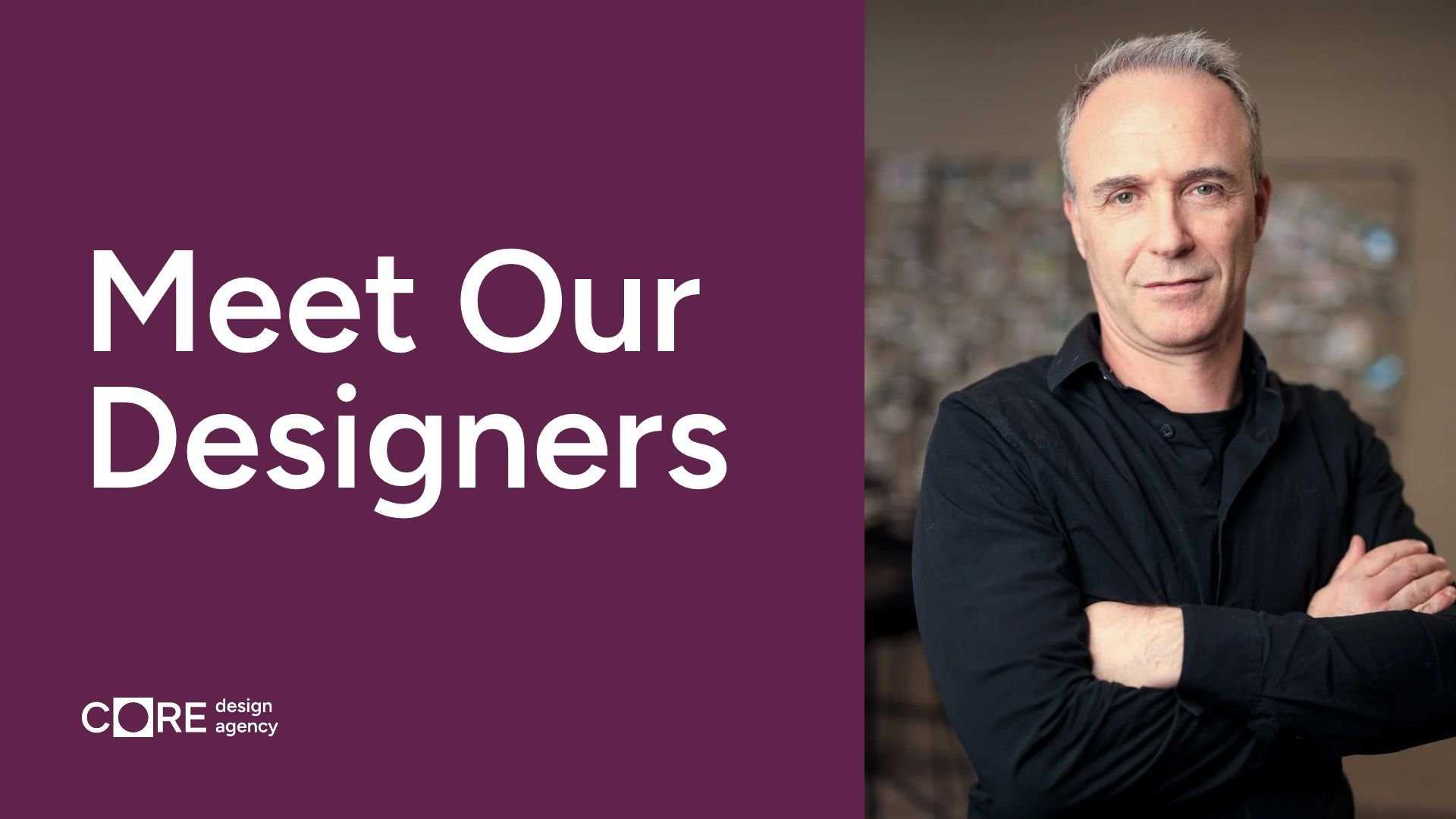
Ask Guido Casalegno what guides his work and the answer is short:
"What drives me at work, as in my everyday life, is a sense of minimalism where simplicity is often more effective and unobtrusive. As Don Norman puts it, good design is invisible, because the ultimate simplicity works so seamlessly and neutrally that users focus on achieving the goals rather than the tool itself."
Guido is a product designer at CORE design agency. Originally from Torino, in northwest Italy, he moved to Finland twenty years ago, and has worked across freelance, consulting and in-house roles in large corporations since. Currently his projects mostly focus on UI, UX and branding work.
From visual craft to product design
In the early stages of his career, his projects were mostly focused on graphic design, print and motion for web and marketing material. Over time, the work moved toward something more structured and meaningful: carefully designed digital applications built on research and teamwork, aimed at solving problems for customers all over the world.
The turning point came at Nokia Design, working on the Camera app.
"I was surrounded by really talented people who are now in key positions around the world. This experience gave me confidence in my skills, and I understood what is required to reach a certain level of quality."
The project drew recognition, and it set a standard he has kept aiming at since. "That was maybe the moment I really thought I was on the right professional path."
The sweet spot between user, business and development
Guido's typical work day starts with dailies, catching up with teammates on what is progressing and what is blocked. After that, the work covers a wide range of activities: mapping end-to-end flows, extracting insights from usability tests and research, and delivering agreed concepts and assets.
Supporting product managers and developers is also essential. "As a product designer, there are three lenses you need to consider: the user needs, the business requirements and the technology aspects," he says. "The intersection of those defines the sweet spot, the ideal delivery."
Guido's current assignments consist of defining the new brand language and design system for the client's digital channels, and solving complex problems in so-called "unhappy flows" that can occur during disruptions in the aviation industry.
The ground keeps moving
During his career, Guido has watched the technology change, and with it people's mental models and their expectations of how interactions should work. He emphasises that you have to keep listening to what is happening and adapt, while keeping your own perspective and critical thinking.
The current shift is AI, and he uses it to a moderate extent within the client's environment. There is a certain excitement in the organisation, a concrete will to experiment with new workflows and technical integrations.
On a personal level, Guido sees AI as a great assistant and uses it for sparring on ideas, testing UIs and summarising research data. However, he says AI shouldn't replace human judgment: "Let's design workflows where a human remains firmly in the loop and in control of the final decisions."
The projects worth saying yes to
Guido is clear about what makes a project work, and the first thing on the list is to partner with clients whose values he believes in, because that shared alignment is what lets him deliver his best work.
He looks for work where he can bring something meaningful to the end user, whether that means helping people take the best picture of a future memory or developing an IIoT application that makes a paper mill manager's daily work easier.
"I like building products rather than doing a quick fix for a few months," he says. Most of his consulting relationships have run two or three years at least, and that length is deliberate. A meaningful experience takes longer than a campaign, and it takes mutual trust.
Room to be the professional you want to be
What Guido values about CORE is the freedom given to professionals.
"CORE gives you a lot of freedom to be the person and professional that you are. It really leaves you the space to develop yourself, without strict principles or a prescribed way of working with clients," he says.
The other good side is CORE's exceptional ability to find for any design professional a good fit with a company or project. CORE knows its designers well enough to put them in front of the right clients, which is a different proposition from a general agency roster.
Guido has met other designers working at CORE multiple times. "CORE represents the full spectrum of possible designers, from visual to business designer, copywriters to design system specialists. All of these people are either well experienced or at least have a solid professional identity: experts in the field, curious to keep up with the tools, willing to build a solid professional offering."
The person behind the work
Guido is happiest outdoors. Most of the weekends between spring and autumn are spent with the family at the cottage, where gardening, collecting mushrooms and berries are among the favourite activities. What he misses most about Italy is the monumental scenery of the Alps, and what he has found in Finland is a version of the same quiet.
"Sitting in the sauna, or on the terrace by the lake. It's just a moment to regain energy."
As for what comes next, he is not certain design is the last chapter. Guido has sometimes played with the thought of having a vineyard. Not a random idea for someone who grew up in Piedmont, one of Italy's great wine regions.
"How could I bring the experience I gained in design into something totally different? I have a feeling I will…"
We are always glad to hear from experienced designers who work this way. Get in touch with CORE design agency.